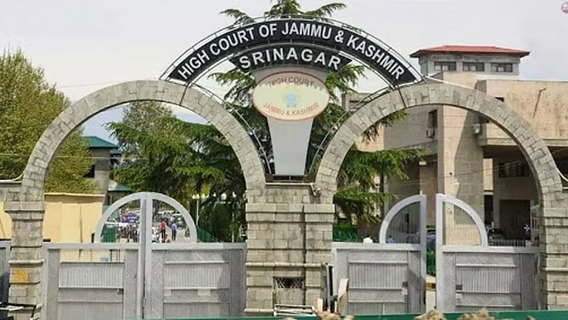
Jammu, May 23, 2025 — In a significant ruling, the Jammu & Kashmir and Ladakh High Court has held that an Administrative Tribunal can exercise its power of review only on the limited grounds enumerated under Order 47 Rule 1 of the Code of Civil Procedure (CPC), similar to the powers of a Civil Court.
Background of the Case
The petitioners, residents of Karan Nagar, Jammu, approached the High Court seeking a direction to the Jammu Municipal Corporation for the demolition of unauthorized construction carried out by the fifth respondent. The construction was allegedly in violation of the sanctioned building plan and the provisions of the J&K Control of Building Operations Act, 1988.
While the Corporation had approved a mixed residential-commercial structure up to the second floor, the respondent allegedly constructed large halls supported by RCC columns, apparently for commercial purposes, in deviation from the approved plan. The petitioners also alleged negligence or collusion on part of municipal authorities.
The J&K Special Tribunal, Jammu, dismissed the respondent’s appeal, noting that the violations were serious and non-compoundable. The respondent then moved an application seeking a rehearing of the appeal. The Tribunal allowed the application and directed the authorities to reassess the violations not as per the prior sanction, but in accordance with prevailing norms. This order was challenged before the High Court.
High Court Observations
Justice Moksha Khajuria Kazmi observed,
“Since the Tribunal’s power to review its decision is akin to that of a Civil Court, the same statutory and judicially recognized limitations apply. A Tribunal can review its order/decision only if any of the conditions specified under Order 47 Rule 1 CPC are fulfilled.”
Referring to Section 22 of the Administrative Tribunals Act, the Bench clarified that although Tribunals are not bound by CPC, they do have the power to review akin to civil courts in specific matters, including review.
On Maintainability of the Petition
The Bench dismissed the writ petition on grounds of prematurity, holding that it was based merely on apprehension.
“Permitting the Municipal Authorities to assess violations afresh does not, by itself, give the petitioners any cause of action to approach this Court. No adverse action has been initiated against them yet.”
On Tribunal’s Power to Recall
The High Court stated that a court or quasi-judicial body may recall or review its order only when the procedure leading to the earlier order is shown to be flawed, even if the order itself does not suffer from a glaring error.
In this case, the Tribunal had reviewed its decision based on newly discovered evidence—photographs produced by the fifth respondent—thereby justifying the review under applicable legal standards.
Final Directions
The Court concluded by upholding the Tribunal’s authority to review its earlier order.
“The Municipal Authorities shall reassess the alleged violations afresh in accordance with applicable rules. They may take action against any unauthorized construction, including that of the fifth respondent and constructions in his vicinity. However, affected parties must be given an opportunity of hearing before any adverse action is taken.”
Case Title: Ravinder Singh & Ors. v. Om Parkash & Ors.
Case No.: OWP No. 522/2013 C/W