




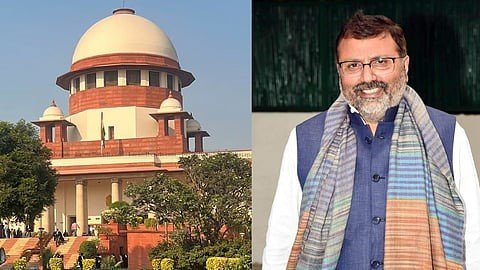
New Delhi, May 8, 2025 — In a stern rebuke against attempts to malign the judiciary, the Supreme Court of India has taken strong exception to remarks made by BJP Member of Parliament Nishikant Dubey, calling them a deliberate effort to erode public confidence in the judiciary and spread communal disharmony. The Court, however, declined to initiate contempt proceedings, citing judicial restraint and constitutional maturity.
A Bench comprising Chief Justice of India Sanjiv Khanna and Justice PV Sanjay Kumar, in its May 5 order in Vishal Tiwari v. Union of India, expressed grave concern over statements made by Dubey following the Court’s hearing on the Waqf (Amendment) Act, 2025. Dubey had accused the CJI of being responsible for “all civil wars in India,” and claimed the Supreme Court was provoking religious conflict—remarks the Court described as “highly irresponsible” and aimed at “scandalizing” the institution.
“Statements Tend to Obstruct the Administration of Justice”: Supreme Court
The Court minced no words in characterizing Dubey’s remarks as a threat to the credibility and integrity of the judiciary. “These statements tend to scandalize and lower the authority of the Supreme Court of India, if not interfere with judicial proceedings, and have the tendency to obstruct the administration of justice,” the order stated.
While dismissing the plea by advocate Vishal Tiwari seeking contempt proceedings, the Court emphasized that the comments do not fall within the exceptions under Sections 3 and 4 of the Contempt of Courts Act, 1971. “There is no ‘civil war’ in India. The statements reflect a penchant for sensationalism and reveal a grave misunderstanding of constitutional roles,” the Bench held.
Hate Speech Must Be Dealt With an “Iron Hand”
In a powerful reaffirmation of constitutional values, the Court warned against the dangers of hate speech and communal incitement. “Any attempt to spread communal hatred or indulge in hate speech must be dealt with an iron hand,” the Court declared, adding that such speech leads to the erosion of dignity, promotes disharmony, and threatens the foundations of a multicultural democracy.
It further emphasized that humiliation or alienation of a targeted group amounts to a criminal offence and must be addressed accordingly under law.
Contempt Power Rooted in Discretion, Not Impulse
Declining to invoke suo motu contempt jurisdiction, the Court clarified that its authority must be exercised with prudence, not provocation. “Courts are not fragile like flowers to wither under ludicrous statements,” the Bench said. “The strength of the judiciary lies in its reasoned judgments, not in retaliatory actions.”
The Court acknowledged the fine balance between judicial authority and free speech, noting that while criticism of judgments is permissible, malicious attempts to discredit the institution must not be normalized. “Judges must rely on the strength of their reasoning and the public’s discernment,” the order observed.
Judiciary Built on Transparency, Accountability, and Public Confidence
The Bench reiterated that the judiciary operates within the constitutional framework and is accountable through mechanisms like appeals, reviews, and curative petitions. “Justice is not a cloistered virtue. It is delivered through open court hearings, written judgments, and fidelity to constitutional principles,” the Court said.
It stressed that judicial review is a cornerstone of India’s democracy, and to question it is to question the Constitution itself. All three branches—the legislature, the executive, and the judiciary—function under the overarching authority of the Constitution, the Bench observed.
Pending Contempt Petition
Another contempt petition against Nishikant Dubey over the same issue remains pending before the Supreme Court, signaling that the controversy is far from over.
This judgment stands as a significant reaffirmation of the judiciary’s resilience and its enduring commitment to democratic ideals in the face of populist rhetoric and political provocation.