




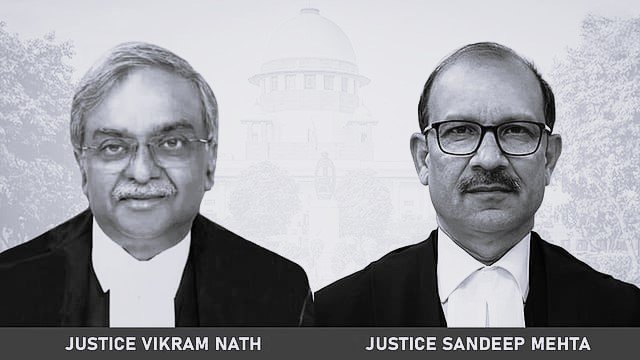
The Supreme Court of India declined to quash First Information Reports (FIRs) filed against two members of the Tamil Nadu Thowheed Jamath (TNTJ) for alleged hate speech. The case, Rahamathulla vs. The State of Tamil Nadu and Ors., involved inflammatory remarks made during a protest in Madurai on March 17, 2022. However, the Court ordered the consolidation and transfer of multiple FIRs to a single court in Madurai for a joint trial to ensure judicial efficiency.
A bench comprising Justice Vikram Nath and Justice Sandeep Mehta described the language used by the petitioners as “highly objectionable” and containing clear elements of hate speech. The Court emphasized that the remarks warranted legal scrutiny and did not merit quashing under Article 32 of the Constitution.
“At the outset, we must note that the language used by the petitioners in their speeches is highly objectionable and definitely discloses the necessary ingredients of the offences alleged… Allowing multiple trials before Courts of different jurisdiction in reference to the speeches of the petitioners dated 17th March, 2022 is not expedient in the interest of justice and the trials deserve to be clubbed.”
— Justice Vikram Nath and Justice Sandeep Mehta
The petitioners were accused of delivering a provocative speech during an unauthorized protest in Madurai. The speech allegedly praised Afzal Guru, a convict in the 2001 Parliament attack, criticized religious practices, and made derogatory remarks against the judiciary, particularly regarding the Karnataka High Court’s decision in the Hijab case. The ruling upheld a Karnataka government order prohibiting hijabs in government educational institutions. Additionally, the speech targeted Uttar Pradesh Chief Minister Yogi Adityanath with inflammatory comments.
As a result of the speech, three FIRs were registered against the accused—two in Tamil Nadu and one in Karnataka. The petitioners approached the Supreme Court, arguing that multiple FIRs for the same incident violated their fundamental right against double jeopardy under Article 20(2) of the Constitution. They cited precedents such as TT Antony v. State of Kerala, Arnab Goswami v. Union of India, and Mohammed Zubair v. State of NCT of Delhi to contend that multiple prosecutions constituted an abuse of process.
The State, however, defended the multiple FIRs, asserting that the speech’s inflammatory nature caused public unrest across different regions, justifying separate legal actions in each affected jurisdiction.
While acknowledging the objectionable nature of the speech, the Supreme Court expressed concern over the potential for conflicting judicial outcomes if multiple trials were allowed to proceed in different courts. The bench noted:
“It is not in dispute that the contents and language of the hate speech attributed to the petitioners are verbatim the same. Thus, we are of the view that allowing multiple prosecutions of the petitioners in different jurisdictions could lead to a serious anomaly with the possibility of conflicting decisions.”
To address this, the Court directed that all three FIRs be consolidated and transferred to a competent court in Madurai, Tamil Nadu, for a unified trial.