
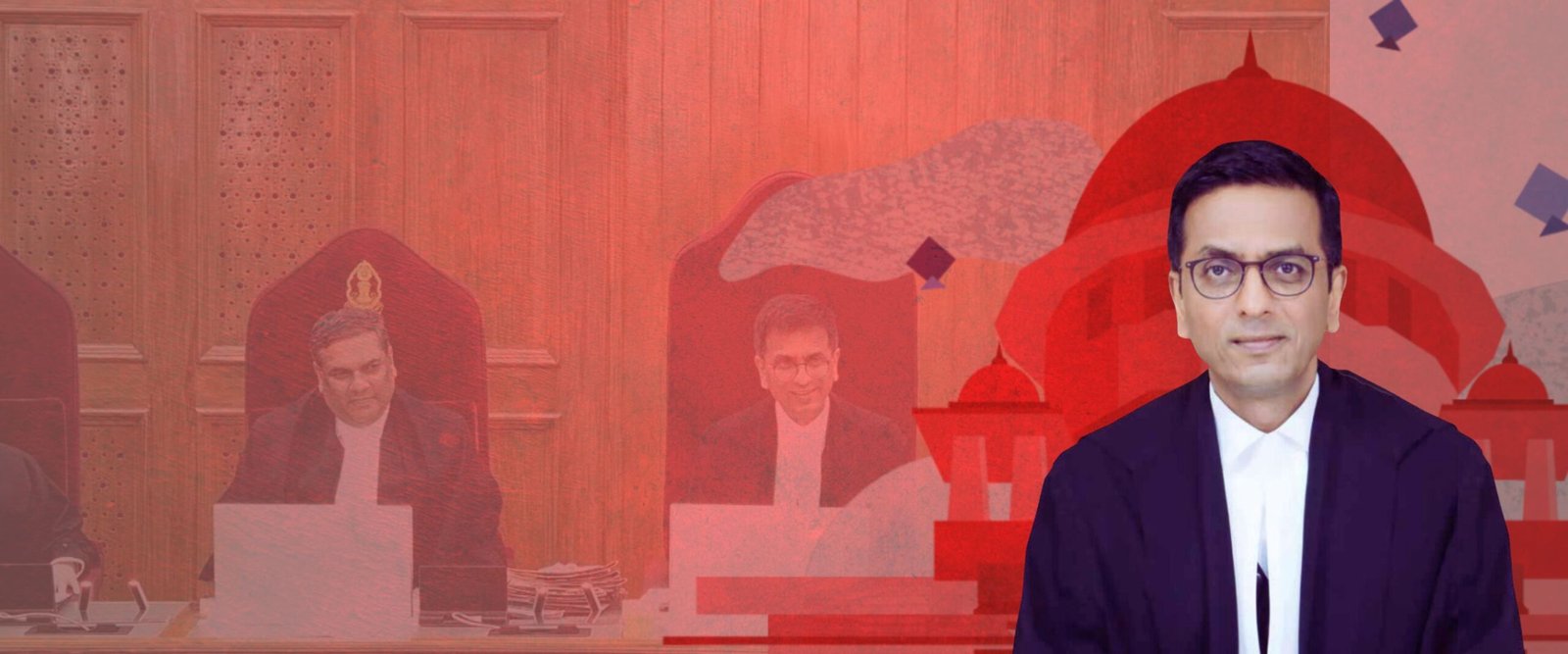
[On February 13, 2025, former Chief Justice of India (CJI) Dr. Dhananjaya Yeshwant Chandrachud, who served as the 50th CJI from November 2022 to November 2024, appeared on BBC’s HARDtalk with journalist Stephen Sackur. The 23-minute interview, conducted at his Delhi residence, covered critical issues such as judicial independence, landmark verdicts, and diversity in the Indian judiciary. Below is a question-and-answer summary of the key points from this insightful conversation, crafted for legal enthusiasts and scholars.]
How did Justice Chandrachud respond to allegations of political pressure on the Indian judiciary?
Justice Chandrachud firmly rejected claims of political interference, citing the 2024 general election results as evidence of India’s robust democracy. He highlighted the success of regional parties in various states, debunking the notion of a one-party state. He also noted that the Supreme Court disposed of 21,300 bail applications in a year, granting bail to numerous political leaders and activists, demonstrating the judiciary’s commitment to personal liberties and the rule of law.
What was his defense regarding Prime Minister Narendra Modi’s visit to his home during Ganesh Chaturthi in 2024?
Addressing concerns about perceived executive-judiciary proximity, Chandrachud described PM Modi’s visit as an “elementary courtesy” between constitutional functionaries. He emphasized that such interactions have no bearing on judicial decisions, asserting, “Our system is mature enough to understand that courtesies do not influence judgments.”
How did he justify the Supreme Court’s decision to uphold the abrogation of Article 370?
Chandrachud defended the December 2023 verdict, which upheld the President’s power to revoke Jammu and Kashmir’s special status. He described Article 370 as a “transitional provision” intended to fade over time, questioning whether 75 years was too short a period for its abrogation. He also pointed to the restoration of democratic processes, with a democratically elected government in place in Jammu and Kashmir by September 2024, as evidence of the judiciary’s role in ensuring democracy.
What did he say about the 2019 Ram Temple verdict and allegations of majoritarianism?
When questioned about reports that he sought divine guidance for the Ayodhya verdict, Chandrachud clarified, “That’s completely erroneous. Social media misrepresentations should not be taken as fact.” He emphasized that his personal faith fosters equanimity, enabling him to deliver impartial justice across religious communities. He rejected claims of majoritarianism, asserting that the judiciary upholds constitutional principles, not communal interests.
How did he address concerns about dynastic influence and lack of diversity in the judiciary?
As the son of former CJI Y.V. Chandrachud, he acknowledged the dynastic perception but clarified that his father advised him to avoid courtrooms during his tenure. Chandrachud pursued legal education at Harvard and entered practice only after his father’s retirement. On gender diversity, he highlighted that over 50% of new district judiciary recruits are women, with some states reaching 60-70%. However, he noted that the higher judiciary reflects older demographics, though he expressed optimism about future representation. Critics on X pointed out that he sidestepped questions about caste-based underrepresentation.
What was his stance on the Citizenship Amendment Act (CAA) and its judicial review?
Chandrachud clarified that the CAA case is still pending before the Supreme Court, with no final judgment delivered. He refuted claims that the court allowed the law to pass unchallenged, stating, “The matter is under judicial review, and the process is ongoing,” reflecting his cautious approach to sub-judice matters.
How did the legal fraternity react to his decision to give this interview?
Senior advocate Harish Salve criticized Chandrachud’s appearance on a foreign media platform, arguing that judges should speak only through their judgments. In a Republic TV interview, Salve expressed concern that discussing sensitive judicial matters with the BBC risked putting the Supreme Court “on trial,” highlighting the need to preserve the court’s sanctity.
What broader insights did the interview offer about his tenure as CJI?
The interview underscored Chandrachud’s transformative legacy, including digitizing court processes, livestreaming hearings, and delivering 93 judgments—more than his four predecessors combined. He positioned the judiciary as a pillar of democracy, navigating complex political and social challenges while striving for inclusivity and accessibility. However, unresolved issues like caste diversity and pending cases like the CAA remain points of contention, as noted in X posts.
Disclaimer: This Q&A is based on publicly available information and does not reflect the official stance of this website. Refer to cited sources for further details.